
A dry stone wall, also known as a dry stone dyke, drystane dyke, dry stone hedge, rock fence, or stone fence, is a wall constructed from stones without mortar to bind them together. As with any dry stone construction, the structural integrity arises from compressional forces and the interlocking of the stones. Such walls are used in building construction, as field boundaries, and on steep slopes as retaining walls for terracing.
Sheep fank, sheep stell, a (dry-stone) enclosure where sheep are gathered for shelter, dipping, shearing etc.
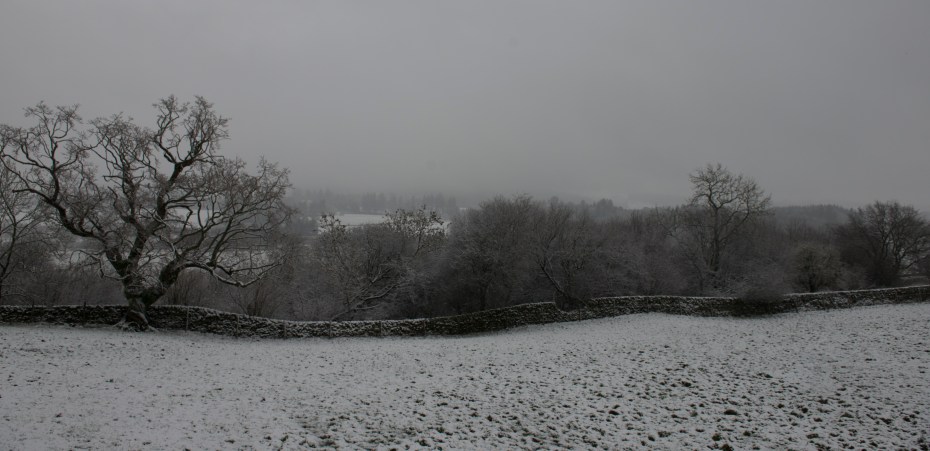
One day of snow in the valley
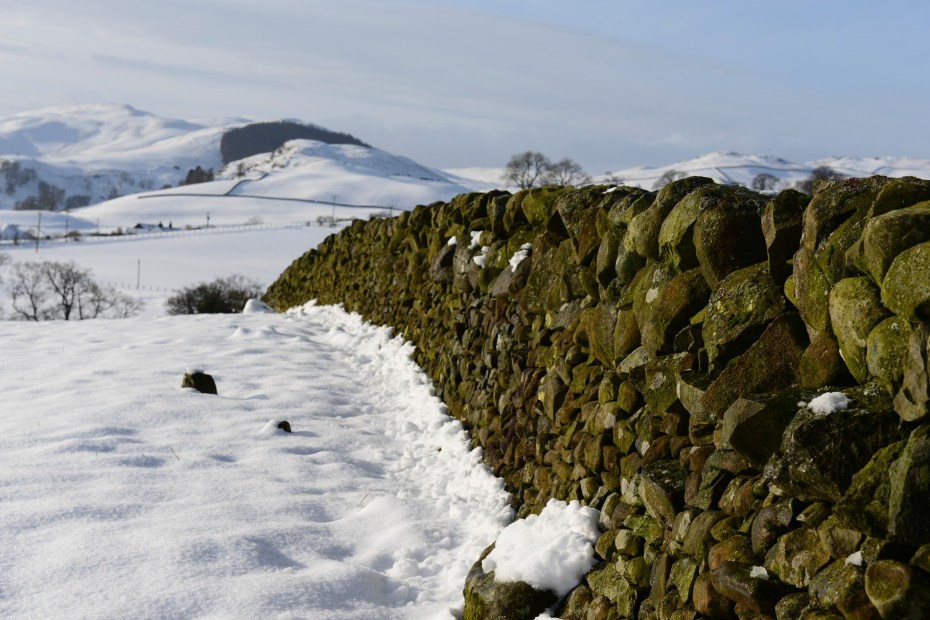
These stone fences are everywhere in Scotland. They are very difficult to date but there are records of some being built around 1300. They are all unique to the part of the country they are built in. In the north they use granite, slate and sandstone. In the south they use Whinstone, a certain kind of stone only found there. You will notice that this Gall0way Fence, a particularly strong fence found only in this area, has the heavier stones on top. This compresses the whole structure and makes for a very strong fence. The fences themselves are very good wind brakes for sheep and shelters for birds and other small creatures.
Most of the fence material came from clearing the land. Some was quarried close to where the fence was built. As the fences were built farther and farther from a quarry, a new quarry was opened closer to where the fence was being built. Back in the heyday of fence building, a good craftsman could place a “Rood” (about 21′ or 3 meters) in a day. Some of the old-timers building these walls would grab the heaviest hammer they had and throw it up the hill as far as they could, they would then declare “this is how much wall I will build today”. Of course the weather had a lot to do with how much wall could be built in a day. A typical double wall weighs 1 ton per 7′ (2 meters) and is between 4-6 feet tall. The art of building these stone fences is fading away but in recent years there have been groups of concerned citizens trying to bring public awareness to the destruction and derelict state of some of the older walls. And there are classes for interested people that want to learn how to make a proper wall.
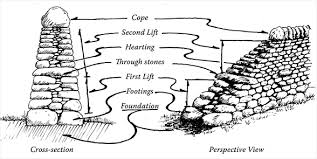
Cross section of a double dry stone wall
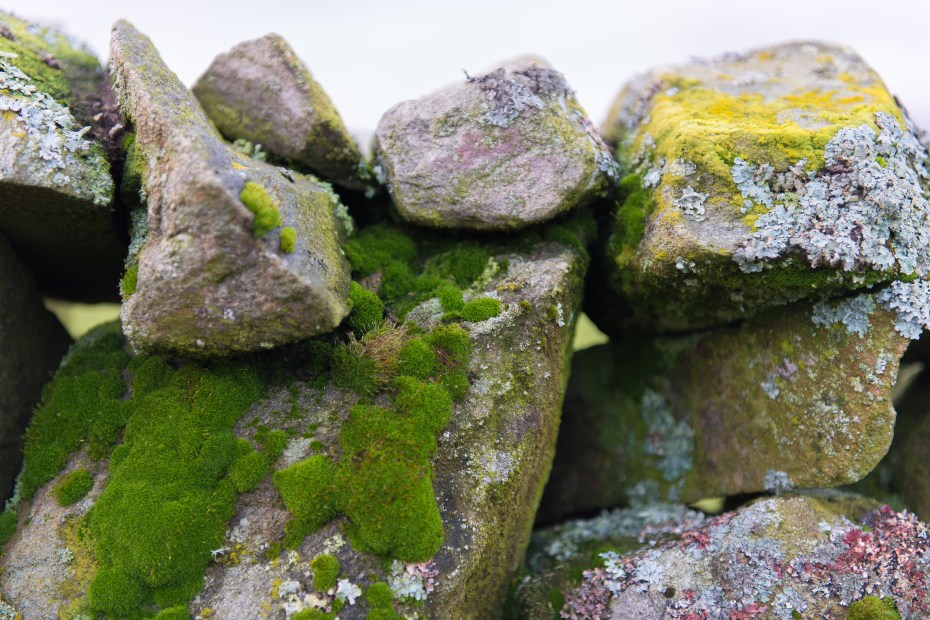
Dry stones with Lichen

This stone wall has gaps between the stones on purpose. It is done this way to discourage sheep and wolves from trying to jump over it because it looks unstable. I have read that some stone walls have gaps at the bottoms to allow rabbits to move from one field to another.

Stone walls are pleasing to the eye, all-most no maintenance (well once every hundred years or so), are sustainable, sturdy and works of art. In my opinion.

